

Praxis: A Crypto Strategy Evaluation Layer for Human-AI Workflows
- Apr 15
- 3 min read
Updated: Apr 15
A centralized workspace for consolidating, comparing, and interpreting crypto trading strategies.





TL;DR
As AI-assisted workflows accelerate the generation of trading strategies, interpreting and validating the results has become the primary bottleneck.
Praxis is a centralized, human-readable UI layer. While enterprise quantitative platforms exist in the market, Praxis is specifically designed to bridge the gap in local Freqtrade workflows, turning fragmented data into structured views to enable a seamless loop of rapid AI generation and confident human decision-making.
The Challenge
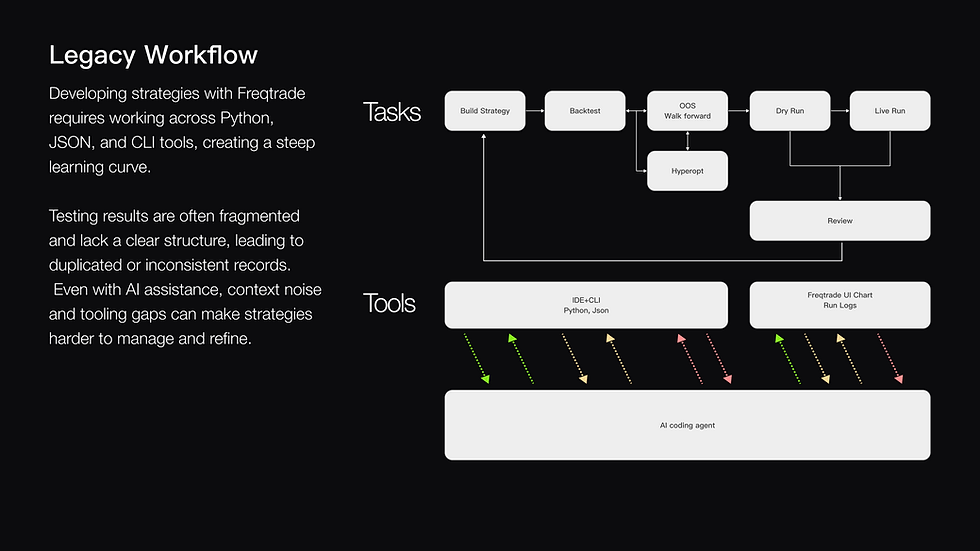
Strategy evaluation typically relies on fragmented outputs (terminal logs, JSON files) and manual interpretation. As AI accelerates our ability to generate dozens of strategies, manual evaluation not only becomes time-consuming but introduces new workflow frictions:
Context Window Chaos: Over long iterations, LLMs frequently lose track of parameter versions or conflate strategies, making it difficult to trace which code produced which result.
Trust & Transparency: AI can confidently generate flawed logic (hallucinations). Without transparent, visual data to verify the actual backtest behavior, it is dangerous to trust machine-generated strategies blindly.
Why it Matters:
When the speed of strategy generation outpaces the speed of interpretation, the workflow bottlenecks. To move forward, we don't just need faster generation—we need an environment that counters AI memory limitations and provides absolute transparency, allowing us to build empirical confidence in our decisions.
The Solution
A centralized, human-readable layer.
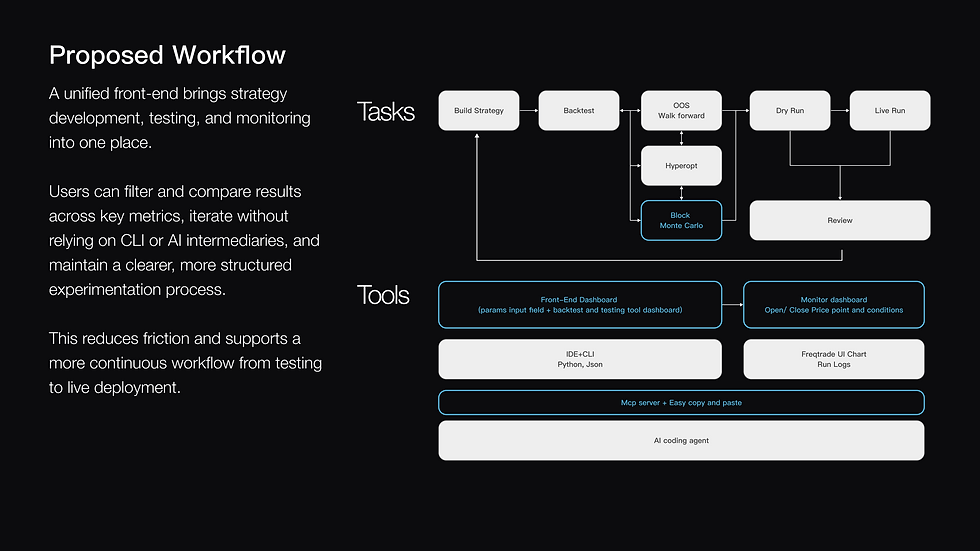
The design direction focuses on creating a workspace optimized entirely for interpretation. Praxis acts as the collaborative bridge between machine output and human judgment, systematically consolidating complex data into actionable insights within a single tool.
Core Experience to Support Iteration:
Strategy Dashboard: A high-level overview of all runs, allowing human scanning to keep pace with machine execution.
Comparison View: A standardized side-by-side matrix that eliminates the cognitive load of manual cross-referencing.
Robustness Analysis: Deep-dives into individual equity curves and Monte Carlo simulations to validate strategy stability.
Design Language: Utilitarian & Familiar
The interface is inspired by the pragmatic design of professional trading terminals. It prioritizes data density, strict hierarchy, and extreme legibility.
Technical Typography:
The typography system utilizes a clear hierarchy with purposeful weight and scale to ensure optimal readability. It features JetBrains Mono for technical data and values to enhance precision, while semantic labeling provides structure and context across all interface elements.
Color System:
Colors are defined semantically to ensure consistent usage and strong contrast across both dark and light modes. Strategy colors are selected to maximize perceptual distance on the color wheel, while staying within acceptable contrast ratios for readability.


Design & Technical Trade-offs
Building this system required deliberate pragmatic compromises to balance UX goals with technical constraints:
Excluding FreqAI for Transparency: While FreqAI offers powerful machine learning capabilities, it was intentionally excluded from this iteration. Its "black-box" nature directly conflicts with the project's core requirement of providing absolute transparency and visual verification for why a trade was executed.
MVP Constraints on Custom Python Logic: Currently, highly complex and customized Python strategies cannot have all their deeply nested parameters perfectly mapped to the frontend UI. To ship the MVP, the system prioritizes standard parameter structures, meaning some granular technical nuances remain accessible only by reading the source code.
The Impact
The implementation of Praxis fundamentally streamlined the research loop.
By offloading the heavy lifting of data aggregation to the system, the result was faster iteration, clearer comparisons, and vastly improved confidence in decision-making. It transformed a disjointed process into a unified workflow where AI generates, and humans quickly and confidently interpret.


